Finance · GA Daily Post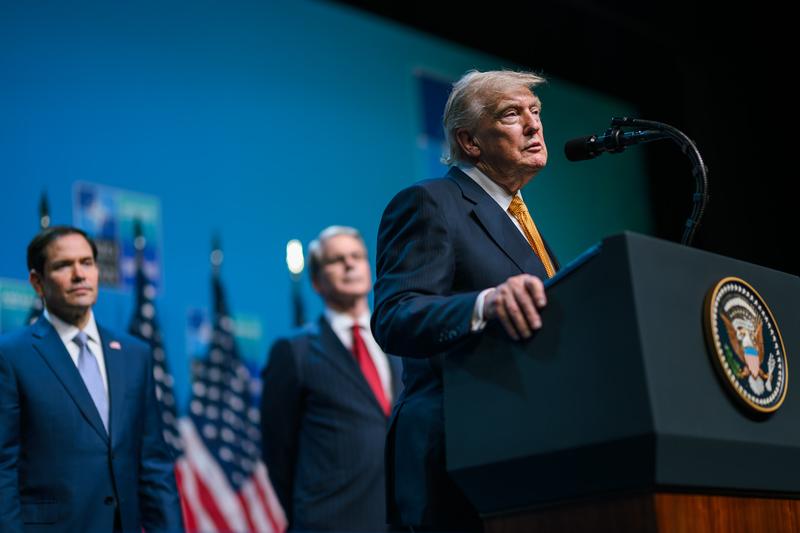
Nvidia ( NVDA +2.30% ) guided for $108.0 billion of fiscal third-quarter revenue in late August, and the forecast carried a footnote: The company is "not assuming any Data Center compute revenue from China" in its outlook. Reaching the figure would require growing about 89% from the prior-year quarter's $57.0 billion. And it assumes nothing whatsoever from the world's second-largest economy in the business that generates over 90% of Nvidia's sales.
On Thursday, Sept. 24, President Donald Trump hosts Chinese President Xi Jinping at the White House, with artificial intelligence (AI) among the main topics on the agenda. Nvidia CEO Jensen Huang is reportedly among the tech executives expected at the state dinner that night. What is China worth to a forecast that assumes nothing from it?
Image source: The White House. The zero is a decision Nvidia's fiscal 2027 second quarter, which ended July 26, didn't need China. Revenue rose 106% year over year to hit $96.2 billion, accelerating from 85% growth the prior quarter.
The data center business contributed $89.0 billion of that, 117% more than a year earlier, and the current quarter's $108.0 billion forecast would be another 12% step up. China is not completely absent, though. Nvidia billed $7.9 billion to customers headquartered in China, including Hong Kong, last quarter -- about 8% of overall revenue, up from $4.0 billion a year before.
Those billings largely come from products the export rules do not restrict, like gaming and workstation chips. But almost none of that money was AI compute. Shipments of H200 chips to China were under 1% of data center revenue in the quarter.
And Nvidia's own filings describe the company as effectively foreclosed from China's data center compute market. Put another way, the chips that drive Nvidia's growth hardly sell into China at the moment. Management, I believe, is right not to promise otherwise.
It took both governments In April 2025, the U.S. government told Nvidia it needed a license to export even its H20 chip, a product designed specifically for China. Nvidia took a $4.5 billion charge when that market closed. By last October, Huang was saying Nvidia's share of China's AI chip market had dropped from about 95% to zero.
Before the limits, China accounted for roughly a fifth to a quarter of the company's data center revenue. Starting in February, though, the U.S. issued licenses permitting Nvidia to send small quantities of H200 chips to particular customers in China. Sales remained tiny anyway.
Beijing limited the purchases, Chinese demand for the chip waned, and Nvidia took a $400 million charge this year on excess H200 inventory. The quarterly filing also notes the company has made only "a fraction of the allowed shipments" the licenses permit. Each H200 bound for China clears a U.S. inspection and comes with a 25% tariff the company hasn't been able to pass along to customers.
Chips have finally begun moving, though. ByteDance and Tencent reportedly took the first significant H200 deliveries into mainland China during the summer, roughly 10,000 units apiece. Even so, Nvidia says that under current rules, it cannot deliver a competitive data center product for broad distribution in China with both governments' approval.
Washington's permission by itself reopens nothing. What could Thursday add? Chip export rules are among the topics investors are tracking this week.
But the summit previews focus on AI cooperation and trade, and easing chip restrictions is widely viewed as the harder ask. And after Sunday's preparatory meeting in New York, U.S. Trade Representative Jamieson Greer said export controls on advanced AI chips were not on the agenda for the AI safety talks there.
Suppose something gives anyway. Even a return to Nvidia's last quarter of H20 sales would be modest. It sold $4.6 billion of H20 chips in the first quarter of fiscal 2026 before the license requirement took effect, and it could not ship another $2.5 billion.
Combined, that's about $7 billion, or roughly 7% on top of the current forecast. Premium Feature Moneyball Superscore 94 /100 Today's Change ( 2.30 %) $ 5.11 Current Price $ 227.38 The previous share of data center revenue would be worth almost $20 billion a quarter on today's base. Of course, no one should pencil that in.
Chinese competitors have had years to fill the gap, Beijing has pushed its tech companies toward domestic chips, and buyers there might not rush back to a vendor their own government has discouraged. Meanwhile, the stock, near $222 as of this writing, trades at about 14 times fiscal 2028 earnings estimates . Whatever is priced in at that level, I'd say it isn't a reopened China.
Sure, a breakthrough on Thursday could make management's forecast look conservative in a hurry. But nothing has to happen at the summit for the investment case to hold. I'd consider buying Nvidia stock today on the strength of a forecast that assumes nothing from China, and view whatever the summit adds as a bonus.
Source: The Motley Fool